Based on the mathematical concepts from Frank Karsten's Magic Math video, we can analyze the Replenish mana base through hypergeometric
distribution to balance the risks of mana screw and mana flood.
Core Benchmarks
To function well, a deck must aim for a ~90% probability of dropping
its third land on turn 3, and a ~75% probability of having its
fourth land on turn 4. Playing exactly 25 lands perfectly aligns
with these metrics.
However, "mana hungry" control decks that desperately need to ensure
a 4-drop resolves on time should push to 26+ lands to elevate that
75% benchmark. A deck can only skip this rule if it compensates with
enough cheap card draw or alternative mana sources.
25 vs. 26 Lands: Hitting the Curve
Lists split about evenly between 25 and 26 lands. Because what
matters most is reliably hitting your key curve turns (3 and 4),
here is how both builds compare:
| Metric | 25 Lands | 26 Lands |
| Turn 3 (OTP) | ~81.9% | ~84.6% |
| Turn 3 (OTD) | ~88.1% | ~90.2% |
| Turn 4 (OTP) | ~67.5% | ~71.6% |
| Turn 4 (OTD) | ~76.6% | ~80.2% |
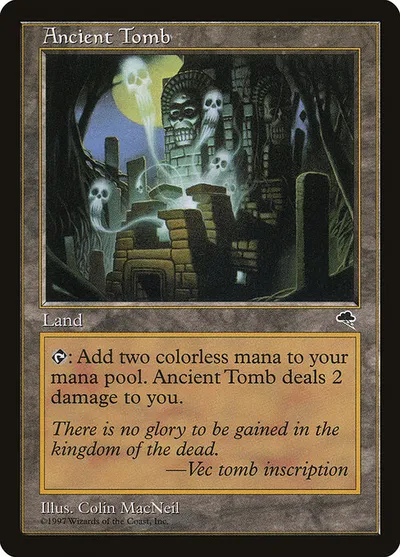
Note: These probabilities calculate raw land drops. While Ancient Tomb acts as two mana and dramatically improves your odds of casting a 4-drop
early, it is safest to build your mana base assuming you won't always draw it;
consider that you only have a 52.8% chance to draw one by turn 4 on the play.
However, because current lists omit City of Traitors to
focus on grinding out attrition games, the 25-land version protects you
slightly better long-term against flooding. The 26-land version accepts
that late-game flood risk to minimize early stumbles.